Artificial Intelligence–Driven Design and Optimization of Lipid Nanocarriers in Pharmaceutics: Opportunities, Challenges, and Future Perspectives
Keywords:
Artificial intelligence, lipid nanocarriers, SLNs, NLCs, LNPs, machine learning, deep learning, formulation optimization, pharmaceuticsAbstract
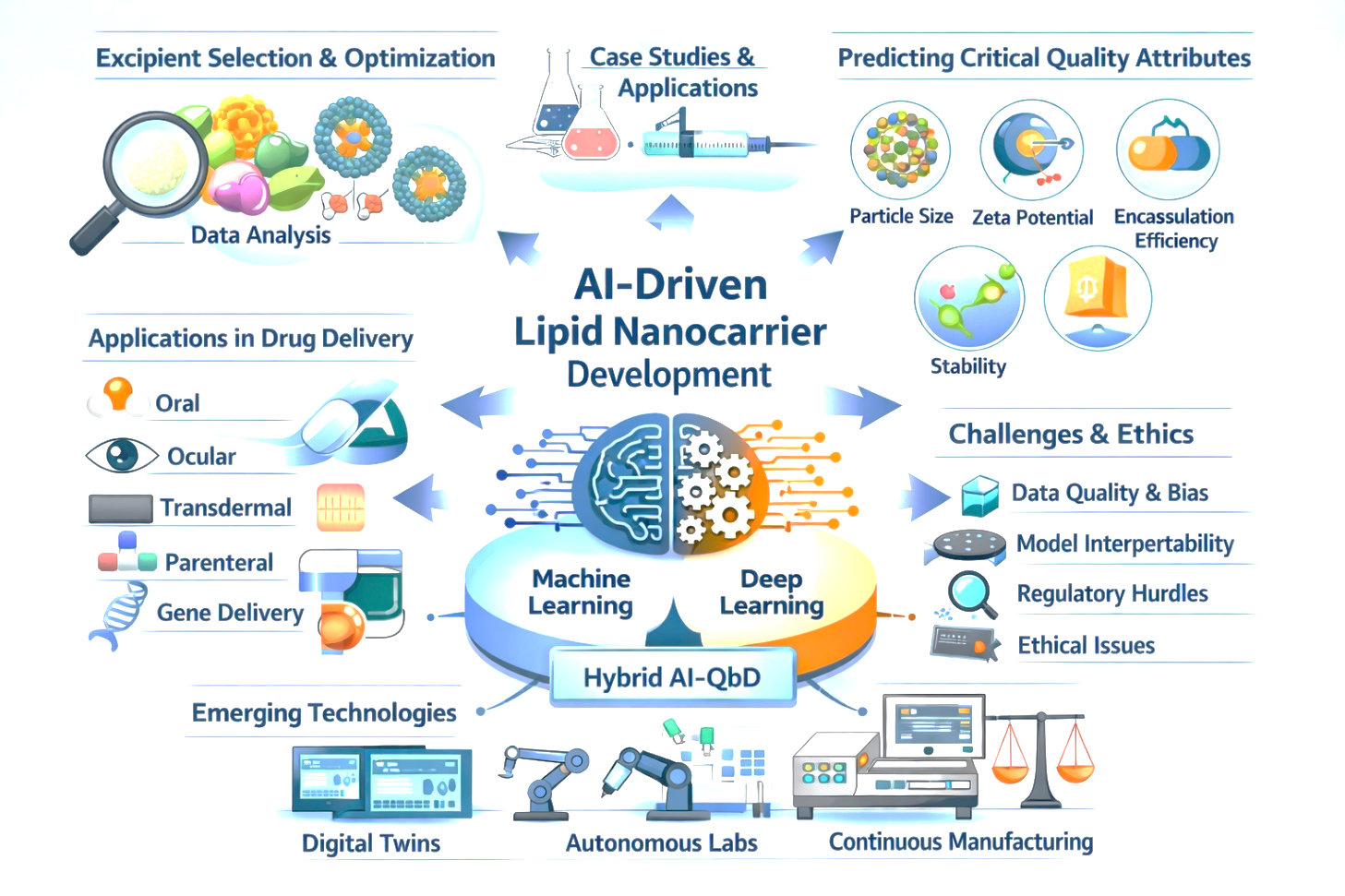
Lipid nanocarriers, which include solid lipid nanoparticles (SLNs), nanostructured lipid carriers (NLCs), and lipid nanoparticles (LNPs) have been discovered to be universal platforms that can be used to improve the solubility, stability, and bioavailability of therapeutic agents. Traditional trial-and-error formulation procedures though historically usual, are time-consuming, resource-intensive and often unable to incorporate the rich, nonlinear interactions that exist between formulation and process variables. Artificial intelligence (AI) is introduced in this analytical review as an effective accelerant to formulation design and optimization in pharmaceutics.
The current paper brings together the available literature on AI-based approaches to lipid nanocarrier development, focusing on the recent advances in machine learning, deep learning, artificial neural networks, and hybrid AI-Quality by Design (QbD) approaches. Special emphasis is given to the use of AI in the choice of excipients and prediction of key quality features, such as particle size, poly dispersity, ζ -potential, drug-encapsulation capacity, and stability under long-term conditions. Cases of AI-aided lipid nanocarrier design in oral, ocular, transdermal, parenteral, and gene delivery are explored in detail. Besides, the review covers the relevant challenges associated with data quality, model interpretability, regulatory approvability, and industrial scalability of AI-based formulation development. The emergent trends, including digital twins, autonomous formulation laboratories, and the combination of AI and continuous manufacturing, are also evaluated. Taken together, this review suggests a framework on which formulation scientists and researchers can utilize AI to revolutionize the development of lipid nanocarriers, as well as to close the divide between optimization on the laboratory scale and a pharmaceutical product with the potential to be translated to the clinic.
Downloads
Published
Issue
Section
License

This work is licensed under a Creative Commons Attribution-NonCommercial 4.0 International License.